

The Rapid Uptake format has been developed with you in mind because it is busy out there.
You are under constant work pressure, don’t really have time to waste, and what you really need is something that you can use – right now – to help with your most immediate challenges and scenarios.
Leadership psychodynamics
for project leaders
The 90-minute Rapid Uptake Module
Duration: 90 minutes
Live lecture, or Online, on-demand
Course description
The Leadership Playbook
The Rapid Uptake materials are an introduction to the psychodynamics that are our driving factor. The factor that makes us do what we do, or don’t.
Armed with this fundamental grounding in psychodynamics, you are able to effectively use the Playbook within your project to evaluate the health status, and more effectively troubleshoot the people-related or people-driven aspects you encounter.
The leadership psychodynamic evolution path
There are three evolution steps to becoming a more rounded and complete leader.
The choice is yours as to how far you want to progress along this path, and with this in mind the program has been built in a modular way to suit your needs.
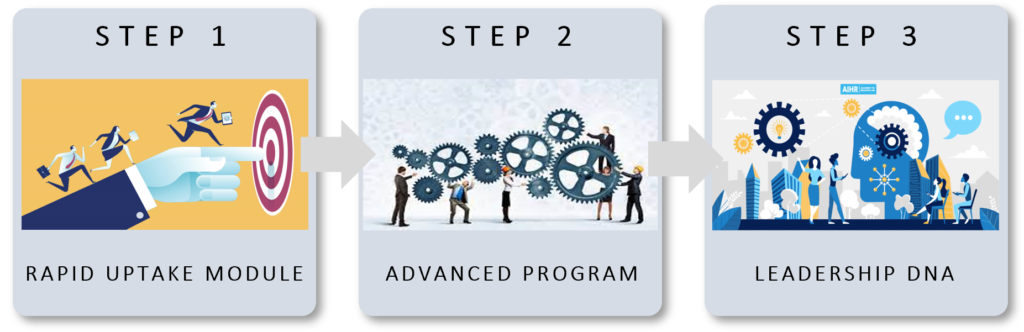
STEP 1
The 90-minute Rapid Uptake module.
The Rapid Uptake module is the first part of the full Leadership Psychodynamics Program …
But if you only want to do the 90-minute module, that's okay. You will already be more equipped than most.

The Rapid Uptake materials are an introduction to the psychodynamics that form a key factor in what drives us. This is the factor that makes us do what we do, or don’t do. Armed with this fundamental grounding in psychodynamics, you are able to effectively use the Playbook within your project to evaluate the health status, and more effectively troubleshoot the people-related or people-driven aspects you encounter.
WHAT'S INSIDE
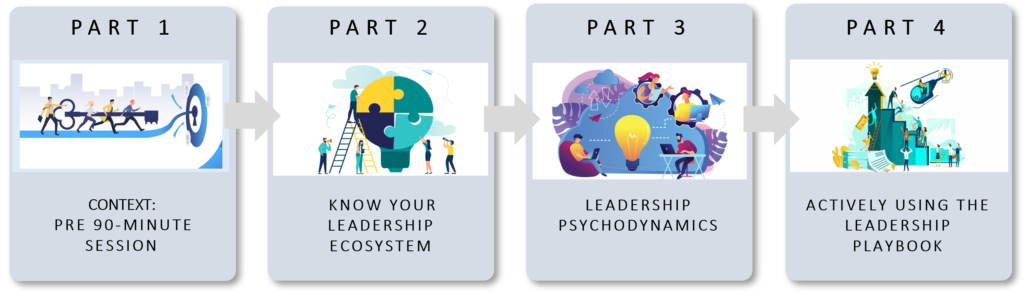
PART 1
CONTEXT
Pre 90-minute rapid uptake session context ... because this is different.
Leadership Psychodynamics is a departure from the norm (the same-old-same-old). As a result, setting the context for the underlying thinking, ideas, and concepts that underpin this leadership theory and model is crucial.
You will access this a week before the 90-minute rapid uptake session via the online campus link sent to you.
You can go through this short contextual section at your own pace before we dive into the 90-minute leadership psychodynamics model and playbook.
WHAT'S INSIDE
(A) WHAT GOT YOU HERE IS NOT NEARLY ENOUGH
The rapid transition from a technical field of expertise where you are training in your technical field and gained years of experience is a rude awakening for most as they move onto the most complex and volatile realm they will ever deal with and doing so with no training and vague frames of reference to go by.
What got you to this point is great, but it only represents a small percentage of a very different ball game that requires a whole new set of skills and fundamental understanding.
Relying on what got you here will fail you going forward. It’s time to up your game to match the game you are now engaging.
(B) THE LEADER PROGRESSION PATH IS FLAWED AND YOU NEED TO CHANGE IT.
Surveys and studies indicate that very few people are afforded a career growth path that includes formal equipping to take on this challenging role.
Most people find their path into a management role (which is a leadership function) coming about through their technical acumen, achievements, and standing amongst their peers. But this is not enough. The human dynamic realm and how you lead it is a complicated and stressful place if you do not understand the basics or fundamentals.
A charismatic nature, or following based purely on technical knowledge, or the ability to coerce will only get you so far.
(C) WHY PROJECT LEADERSHIP AND WHY IS IT IMPORTANT?
“Isn’t my project management training and knowledge good enough? Why do I need ‘Leadership?”
There is a delineated distinction between topics such as administration, direction, supervision, management, and leadership.
Leadership deals with the facilitating of all these topics and functions. However, leadership of the human dynamic is the most crucial factor but is the least focused upon skill across all sectors.
As a project or program manager you have equipped yourself with the technical aspects of managing a project (the ‘mechanics’), but have you equipped yourself with the most dominant factor that drives the entire project ecosystem – the human dynamic (people)?
(D) THE PROJECT ECOSYSTEM YOU MUST LEAD
Project environments are among the most complex and dynamic you can find. It is an ecosystem of diversified, varied, and conflicting systems and players.
The project ecosystem is an eclectic blend of internal and external factors that on the surface or an organogram seem to make sense, but when it comes to leading this concoction by aligning them on an endgame and managing the gameplays along the way, it is easy to see how it can quickly become confusing – if you know what the true picture looks like.
So what does the true project ecosystem look like?
(E) PSYCHODYNAMICS
What is psychodynamics and what does it have to do with managing a project?
Just to get you started, I will give you a quick overview to help answer the question.

PART 2
KNOW YOUR LEADERSHIP ECOSYSTEM
Reducing the ecosystem to 3 core components to focus on.
Understand the landscape, the arena, the components of the ecosystem you operate within.
People, environment, systems, resources, and alignment on the endgame.
How it is all inter-connected and interactive.
The alignment path (Cradle to grave alignment).
WHAT'S INSIDE
(1) THE LEADER'S ACUITY AREAS

These 4 acuity areas are your personal focus areas
-
- This is where you will find what you must manage in order to lead.
- This space is where you will find your leadership competencies
- These 4 Acuity Areas are also the power domains that drive your project ecosystem and everything that happens in it.
(2) PEOPLE ARE MORE THAN 75% OF THE SUCCESS EQUATION
See why the human dynamic is the key to success
PART 2 TAKEAWAYS
This is where you will be once you have completed Part 2
A. You will, have a broader perspective and understanding of the multiple dynamic components in play within your project ecosystem.
B. This altered viewpoint of your ecosystem will give you the ability to be more aware of the components in play and their dynamic interplays, and cause-and-effect connections and interactions.
C. It will help you understand the human dynamic, the people aspect of your projects better, and through this reduce the amount of events that cause problems, or to better deal with the people-related challenges that arise.

PART 3
LEADERSHIP PSYCHODYNAMICS
Understanding and managing expectations and the human dynamic
Here you will learn what the fundamental drivers are that make you do what you do as a leader, and understand what sits behind what drives those you lead.
Learn about the Psychodynamic Affect which is responsible for the dynamism within a team ecosystem and how the four key domains work for or against each other to produce positive or negative scenarios.
WHAT'S INSIDE
(3) THE HUMAN DYNAMIC
The complex, volatile, powerful people factor
-
- People are involved across all phases of the lifecycle. It starts with people, progresses through people, and ends for the benefit of people.
- It’s a complex and volatile realm filled with the potential to produce great things, mediocre things, or destroy things.
- It’s the most powerful element in the success equation. It is also 2/3rd’s of the success ratio.
(3b) PROJECT ECOSYSTEM & THE HUMAN DYNAMIC
What exactly is going on within this ecosystem?
-
- Understand the 4 inter-connected domains that rule the entire project ecosystem.
- Psychodynamics is 75% plus of the equation. The mechanics is less than 25%.
(4) THE PSYCHODYNAMIC AFFECT
What exactly is going on within this ecosystem?
-
- Understanding the dynamic components and interactions that shape and drive your project space.
- Understand the dynamic relationship between people and everything else.
- Learn how to use the psychodynamic affect to your advantage instead of letting it trip you up.
(4b) THE EXPECTATION FACTOR
Everything is driven by expectations – everything
-
- A look into the power domains that are at the core of what we think, feel, and do.
- See how you can manage this expectation realm to lead your projects better.
(5) ECOSYSTEM ALIGNMENT AND BALANCE
Alignment and balance within the ecosystem is key to project success
-
- See how everything in the Psychodynamic Affect works for or against alignment, balance, and successful project outcomes.
PART 3 TAKEAWAYS
This is where you will be once you have completed Part 3
A. You will have a totally altered viewpoint on what leadership is, what the actual dynamics are that are in play, and how to use these to effectively lead your space.
B. How the Psychodynamic Affect is at work around you without you being aware of it, and how you can harness the power contained in this Affect.
C. Knowledge of the Expectation Factor (The power of expectations) and how to understand your motivating drivers and those that drive others around you.
D. See why the human dynamic is more than 75% of the success equation of a project, and how to use this to your advantage when managing your project.
E. Know how to establish and maintain the crucial balance in your project ecosystem.

PART 4
SIMULATION: USING THE LEADERSHIP PLAYBOOK
Applying the leadership psychodynamic model to your scenario
This section is about equipping as a leader with the playbook and the fundamentals as rapidly as possible.
As you progress through this section, you will learn how to apply the psychodynamic model as you use the playbook to simulate a current real-time scenario you are dealing with.
WHAT'S INSIDE
(6) PLAYBOOK OVERVIEW
How do I use this Playbook?
You have the playbook in your hands, now let’s see how it comes together and how you will use it.
(7) THE GAME PLAY FRAMEWORK
All the game plays contain the basics
Each of the four game plays are built on a framework that forms the foundation upon which everything else is built. Us this framework to establish best practice habits and operating protocols.
(8) SIMULATION (PLAY #1: TROUBLESHOOTING SCENARIO)
Using the troubleshooting game play
- Learn what the game play is about, and,
- Use the troubleshooting game play to diagnose the problems or challenges in your leadership ecosystem.
(9) START WITH THE PSYCHE DOMAIN
Everything is driven by expectations – everything
-
- Learn how the Psyche Domain is at the core of almost all human dynamic matters.
- Use the Psyche Domain Health Check to evaluate the human dynamic state.
- Learn how this applies to individuals and groups.
(10) PSYCHE DOMAIN SIMULATION & HEALTH CHECK SCORE
Applying the Psyche Domain Health Check to your scenario
-
- Simulation part 1. Use the game play and Psyche Domain Health Check to evaluate the balance and alignment status of your individual team members and the collective group.
- Determine which Power Dimension in this Domain is the antagonist in the mix.
- Pinpoint where to start shifting the balance to regain alignment.
(10) SYMBIOSIS
The 4 inter-connected and interactive leadership domains
Symbiosis is where you learn to use the visual tools of the playbook to see how each domain and their components are inter-connected, and how they assert a push and pull effect on each other to balance or un-align your leadership ecosystem.
(11) LOGIC DOMAIN SIMULATION & HEALTH CHECK SCORE
This is the ‘mechanics‘ within the mix.
The Logic Domain is the ‘mechanics’ in the leadership mix. This is where your project management frameworks, methods, models, tools, and processes are found. It is also the space where internal organisation and external administration and controls exist.
Learn what this part of the ecosystem really looks like and how it will relate to the other Domains in the leadership mix.
The Psychodynamic Affect in action
Learn how the Tribe Domain is influenced and impacted on by the other Domains, and how this Domain in turns influences, shapes, and impacts on the other three ecosystem domains.
(12) ETHOS DOMAIN SIMULATION & HEALTH CHECK SCORE
Values, principles, trust, alignment
The Ethos Domain is where the organisation culture and the project management culture is defined and functions.
Learn how this domain plays a crucial role in teamwork, a leader’s ability to influence, and how it will make or break a tribe and therefore project outcomes.
It is often debated and rarely understood and even more rare that it is applied, and therefore is a major contributor for short and long term cohesion, alignment, and success.
As a leader, you must understand the power of this domain and how it is a key driver in how the other ecosystem domains function in a balanced or unbalanced state.
The Psychodynamic Affect in action
Learn how the Tribe Domain is influenced and impacted on by the other Domains, and how this Domain in turns influences, shapes, and impacts on the other three ecosystem domains.
(13) TRIBE DOMAIN SIMULATION & HEALTH CHECK SCORE
This is the team, group, or alliance space. Here you make or break teams.
Teamwork and team cohesion are what so many speak about but few understand how to achieve it.
In this Tribe Domain section you will see what brings people together, keeps them together, and what the factors are that establish and maintain alignment and cooperation, and how these same components can weaken or destroy the team and collaboration you strive for.
The Psychodynamic Affect in action
Learn how the Tribe Domain is influenced and impacted on by the other Domains, and how this Domain in turns influences, shapes, and impacts on the other three ecosystem domains.
(14) TOTAL PSYCHODYNAMIC AFFECT HEALTH SCORE
Bringing it all together
In this section you will learn how the full leadership psychodynamics framework comes together to give you an overall health status picture of the ecosystem you are leading.
You will see via the graphic interfaces of the playbook which domains are impacted within the troubleshooting simulation, and build a rapid picture of where you need to begin systematically shifting the right components in the mix to get back on track.
(15) THE SHIFT (MAKING ADJUSTMENTS OR CHANGES IN THE RIGHT AREAS)
Never apply the hit-and-miss approach again
You will have completed your health check of the scenario and know where to begin the shift process.
This is the final stage in the simulation where you diagnose your real-time scenario and map out your plan of action to bring our project out of troubleshoot mode and back on track to achieve the expected outcomes.
PART 4 TAKEAWAYS
This is where you will be once you have completed Part 4
A. The ability to effectively use the leadership playbook to lead your ecosystem.
B. Have simulated a real-time troubleshooting scenario you are currently busy with.
C. Be able to use the playbook in any of the four scenarios.
D. Be in a better position to lead your project and the human dynamic you rely on for achieving success as you effectively tap into their potential.
E. Massively reduce your stress through knowing what the areas are that if neglected or inflamed become your stress.
Instructor

Steve Vanstraaten
Leadership coach and architect of the Leadership Psychodynamics Model.
Portfolio, program, and project manager (Global and complex projects)
Project and portfolio consultant to multi-national organisations