









TRANSITION FROM VOCATION TO LEADER

THE MILLENNIAL LEADERSHIP CHALLENGE

CONFIDENCE


As someone who has to lead others, confidence is vital.
Confidence in yourself, and the confidence others have in you.
This you will get from embracing and applying solidly grounded leadership fundamentals.
A guiding model that centers, aligns and focuses you and your team in any scenario.


The psychodynamics of leading others is a complex environment.
The Blueprint takes all these complexities and distills it into one simplified interface
that is easy for you to use


More than 3000 touch-points
to manage each day

Condensed to
16 focus points

Balance & Alignment
of expectations

There are more than 3 000 key touch-points a leader must deal with on an ongoing basis.

The Blueprint reduces these to just 16 key points, that when in balance, will automatically manage the other 2 984 plus points.
(Mastering this resides within understanding the Blueprint model)

Blueprint -Circle_1

As a leader,
a blueprint equips you with the foundational building blocks and approach to follow that will help you to efficiently, effectively and confidently lead others.

2Blueprint -Circle_1

A blueprint anchors you.
It will provide you with a solid grounding in any situation and allow you to focus on using your natural abilities without having to speculate on what the basics are

Blueprint -Circle_3

Under pressure
it equips you with a solid reference framework and a checklist to ensure that you stay with the basics and help you avoid straying off the proven path

Blueprint -Circle_4

It has repeatability;
a means to pay-it-forward and build a culture of leadership. A blueprint places in your hands the means to equip your team to take their leadership position. One of the key traits of a leader is raising up the leader in others, and when equipped with a blueprint, reproducing the basics that lead to success becomes easy.

Aligment

Here's a brief overview of the Blueprint for you

This is how we see it.

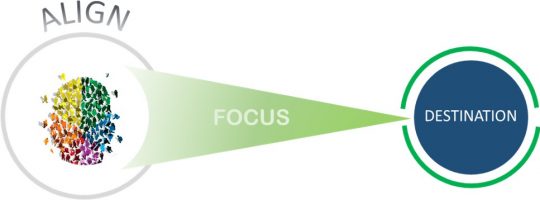
“Leadership is the ability to facilitate the alignment of
different and conflicting expectations, and moving them
toward a defined end-game (a common vision of something, a mission, objectives, goals)”

Align_Focus_Target_1

But what are expectations, and how do you go about aligning them?

[Look at the 4 building blocks below]

Aligment

BASIC BUILDING BLOCKS OF ALIGNMENT

All vocational areas and skills have a set of basic building blocks or rules that they follow in order to be successful. When it comes to leadership, these basic building blocks, or blueprint, are not readily available.

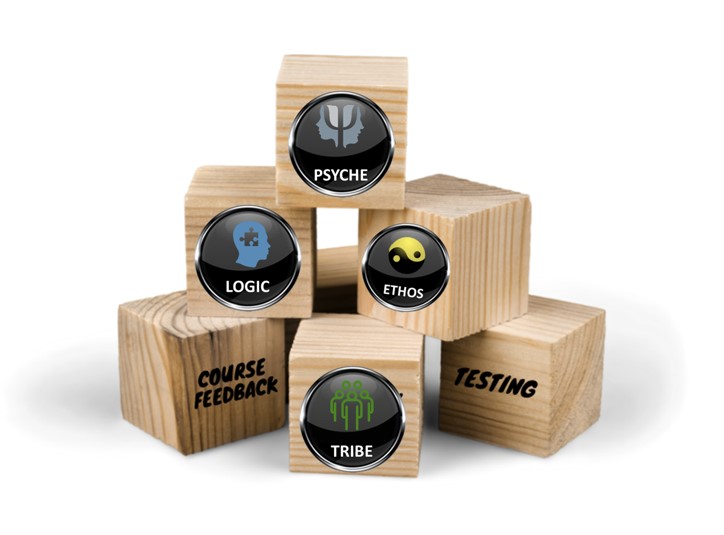
At the core of expectation alignment is the cluster of 4 building blocks that are always in the mix

Each of these zones play a crucial role in the psychodynamic realm.
They are key in achieving and maintaining the alignment of everyone involved


Psyche_Logo

PSYCHE

This is the expectational realm, the place where five of the most powerful dimensions in our lives continually interact with one another. It is where we constantly search for the answer to “what’s in it for me”, and where we align with something or move away from it.

It is where our emotions, worldview, behaviors and the value we attach to everything exists. This is everyone’s headspace, where expectations get their life, and where alignment takes place or not.

Logic_logo

LOGIC

All those management theories, methods, and tools you know about, have studied, or are going to learn – this is where they find their true usage. In this domain you will find the essential components required to keep the Psyche domain balanced. It is here that you will find the formula to set things up for success from the outset; but it is also the place where you can determine what is causing the Psyche domain to be out of balance, or out of alignment.

Ethos_logo

ETHOS

Everything can be used for good or evil. It all depends on this domain. You will either subscribe, or not, to the guiding beliefs or ideals of an individual or group. If your ethos does not align to that of the group, team, organization, company or anything else, then alignment will not take place. This is a space that is purely between you and yourself – but it is susceptible to manipulation by others.

Tribe_logo

TRIBE

This is the team domain where alignment is essential. Here you manage expectations internal to the team and external. It is the space where we find our meaning in what we do and where we come together in the melting pot that is the domains of Psyche, Logic, and Ethos. This collective space has a direct bearing back on all three of the other building blocks. It is where you live and see the heartbeat, and where you will experience the harmony and balance, or the opposite. This is also where everyone needs to lead.

The_basics_circle

BASICS

Every successful athlete, artist, performer, engineer, doctor knows the importance of the basics, and doing them right. It is no different for any leader. The basics give you your solid grounding and center you regardless of changing scenarios.

Management is only one small subset of the basics. Leadership has its own set of basics that you need to know about.

Building_blocks_circle

BUILDING BLOCKS

Building blocks are the collection of the right ingredients or components required for success. The order they are used in and how they inter-relate are of equal importance.

When you come to understand what is in play within the leadership realm, and how all the key facets that are the building blocks interact and work together; then you will be properly equipped to begin your journey as a leader of others.

Playbook_circles

PLAYBOOK

We are all unique with our own strengths and dominant characteristics that shape how we go about things. As a leader this applies to you. Every playbook, no matter how it is developed to suit the individual, is always anchored on the basics. However, each playbook needs to be shaped for the individual in order to extract the maximum efficiency, effectiveness and results.
Built on the basic building blocks, you will be able to develop your personal leadership playbook.

BEGIN YOUR TRANSITION


60 minutes icon-2

60 minutes
to change your perspective on leadership

Contained within the first part of the Program is 60 minutes of information that will challenge your perspective on leadership. It will test the norm and prevailing conventions, and it will give you the building blocks to rapidly change how you lead and the results you get. It will also place in your hands a model that challenges and changes how you go about leading your own life.

6 hours icon-2

6 hours
that will change your ability to lead

It takes 6 hours to move you onto changing your ability to lead others. Within this time you will have in your hands a blueprint and a playbook to use that will make you a more confident and effective leader in almost any situation. You will immediately be able to apply this to your current scenarios and even be able to evaluate the health status of your current team and identify where to make a change that will shift you in the right direction.

24 hours icon-2

24 hours
to totally transform how you go about it

The full completion of the Leadership Blueprint Program should take an investment of 24 hours of your time. It will transform how you go about leading by building on the basic building blocks you have learned, and equipping you to the next level of leading others. It will also have equipped you to effectively begin with the Leadership Simulations that will keep you on top of your game.

What is Leadership Psychodynamics

New managers are not ready to lead, and the transition path is to blame.

THERE IS A DISTINCT FAILURE IN THE EXISTING PATH MANAGERS AND LEADERS TAKE

Listen to the Podcast

New managers are not ready to lead, and the transition path is to blame.

85% of first-time or new managers receive no training in management, and the number is even higher for those who receive no training in leadership.

But before we go further, we need to establish a quick distinction between what management and leadership is.

Leadership has to do with the psychodynamic arena of leading people.

Management is the function or descriptor of the technical skills required to manage multiple facets of an operational nature.

Management is not a position or title. It is a function of leading others. Every manager is firstly a leader of others, and complimentary to this and interwoven into it are the facets of management processes that serve to guide how you technically do what you do.

Being good at your technical job does not automatically qualify you to lead others. Yes, it is one part of the equation and an important one. You have to know your stuff to lead others in that area.

Way too many people who step into a role that requires leadership firstly have no concrete concept of what leadership is. To boot, they have no training in leadership. They are only armed with a vague concept or opinion of it. A speculative viewpoint derived from hurriedly reading through some materials in an attempt to make sense of what the heck they just stepped into.

This is normal after the euphoria of promotion and its perceived perks has worn off. Suddenly, the all too naked reality of the challenges the human dynamic throws your way is staring you squarely in the face. And, it is at that moment you realise you have no base foundation or reference model for dealing with it.

And as we think about this, we should begin to see the irony.

People spend years studying, being coached and mentored, and honing their technical skills. It follows a robust approach of establishing the fundamentals, evaluating and then progressively building the advanced capabilities on top of this foundation. As a result, you become very good at what you do.

Then overnight (through promotion or incidence) you find yourself in a new demanding role, in arguably the most volatile arena you will find yourself. And this occurs with no training, no coaching, no experience – and not even a guiding roadmap, playbook or blueprint to ground you in what you are embarking on. All you are left with are the examples of those around you – be that good or bad – but how would you know in the absence of a proven model?

So here is the question. Why suddenly does a proven approach in one area of your career – progressive training and experience in your technical skills – suddenly get ignored or thrown out the window when it comes to taking on the complex responsibility of leading people.

I think I need to give this more perspective, so let’s draw a parallel with aviation. Imagine that for years you have been around aircraft and maintaining them. You were trained, coached, and certified, and through this, you have become very good at what you do.

Then overnight you are thrust into the pilots’ seat and required to fly the plane with 300 passengers on board.

Sure you have observed others fly, read a few articles on flying, and even sat in the cockpit on a few flights – but you have never piloted a plane, and now you must fly it with 300 people. Don’t forget the crew on board, the air traffic controllers, and the ground crews. They are all in the mix too.

It seems ridiculous that we would subscribe to something like the example. Yet every day, this is what happens. And now we wonder why so many managers and those they are responsible for, crash and burn.

New managers are promoted into roles that consist of 90% leadership abilities to effectively do their jobs. Yet, they are lacking in the most basic understanding of the fundamentals needed to take on this role. They are, therefore set up to perform poorly or fail.

Vocational or technical skills are one thing. Dealing with the complexity of the human dynamics arena and leading others is a whole other ball game. You cannot take on this level of responsibility without being equipped to do so. Just like the 300 passengers on that plane, as a leader, you are responsible for them all. This is the role you have taken on.

But there is more to this leadership progression story. Management training (if you have received it) is not leadership training. Most leadership training programs are nothing more than management fundamentals packaged and labelled as leadership. They are devoid of the leadership (psychodynamics) basics.

Some include leadership tenets – which is good advice and habits – but they lack the fundamental grounding. They are therefore used out of context and become either ineffective or destructive.

Management training is essential as it forms part of the leaders’ toolkit. However, management is not the toolkit and not even the most important tool in the toolbox.

Leadership is the overarching aspect of the management role, and it requires knowing the fundamentals of the psychodynamics of leading other people.

The downside to a lack of leadership equipping.

Research reveals more than 80% of new managers underperform, or fail to impress during their first two years in the role. The added downside is that these managers are shaped by these experiences in the first year, and this influences their leadership styles throughout their careers.

The knock-on effect is that as the role-model for the next generation of managers/leaders, they are passing on a flawed DNA. A flawed model that leads to an ongoing approach of authority-based managing, coercing, and aggressive tactics used by those in management positions – because this is all they know, or pursue out of desperation.

As this continues, there is no room for leadership to take place, and the potential talent within the people working for the manager goes wasted. (75% of people leave their jobs because of their managers)

Currently, poor leadership is costing organisations and business through;

Lack of internal and external alignment

Loss of key staff

Disengaged workforce

Low efficiencies

Loss of customers as a result

More than 70% of managers surveyed are stressed, and the same percentage of managers do not enjoy their jobs. 90% of your function as a manager is to lead. If you do not know what that is or what the fundamentals are, then this should not be a surprise.

THE UPSIDE OF TRAINED AND EQUIPPED LEADERS

With the right approach and through equipping managers to be leaders and developing a broader leadership culture in the business, you can spend more of your teams time and energy on leveraging opportunities. Here are the benefits;

An aligned organisation that reduces internal and external conflicts of interest

Reap the rewards of high levels of efficiencies

Retaining key staff and the core knowledge and experience that is crucial to the business

The advantage of an actively engaged workforce

Motivated and less stressed managers who are more engaged and therefore effective

Retention of customer that are crucial to the profitability and sustainability of the company.

Organisations with a leadership culture are 80% more likely to obtain and hold a competitive advantage in the marketplace.


Read more

Studio photography secrets

“Lesser artists borrow, great artists steal.”

– Igor Stravinsky

In consectetur viverra ante, eget vulputate magna aliquam in. Ut sem arcu, consequat quis lacinia id, ultrices in felis. Suspendisse potenti. Donec venenatis, eros scelerisque volutpat fringilla, mi diam varius ligula, in eleifend lectus est fermentum lorem.

Duis volutpat sollicitudin ante ac hendrerit. Ut fermentum elit at augue vestibulum feugiat. Integer ac magna lacinia velit bibendum ornare.

Donec venenatis, eros scelerisque volutpat fringilla, mi diam varius ligula, in eleifend lectus est fermentum lorem. Duis volutpat sollicitudin ante ac hendrerit. Proin tellus mi, eleifend non venenatis sit amet, ullamcorper at ligula. Nunc molestie dolor nec magna fermentum in pharetra orci mollis.

“Vision is the art of seeing what is invisible to others.”

– Jonathan Swift

Donec venenatis, eros scelerisque volutpat fringilla, mi diam varius ligula, in eleifend lectus est fermentum loremvolutpat sollicitudin ante ac hendrerit. Ut fermentum elit at augue vestibulum feugiat. Integer ac magna lacinia velit bibendum ornare.

Proin tellus mi, eleifend non venenatis sit amet, ullamcorper at ligula. Nunc molestie dolor nec magna fermentum in pharetra orci mollis. In consectetur viverra ante, eget lorem ipsum dolor aliquam in.

Ut sem arcu, consequat quis lacinia id, ultrices in felis. Suspendisse potenti. Donec venenatis, eros scelerisque volutpat fringilla, mi diam varius ligula, in eleifend lectus est fermentum lorem.

Read more

Corporate identity: core design principles

Main secrets

Cum sociis natoque penatibus et magnis dis parturient montes, nascetur ridiculus mus. Etiam dui libero, tempor quis congue in, interdum eget tortor. Vivamus aliquam dictum lacus quis tincidunt. Phasellus rhoncus ante sollicitudin nisl consectetur ultricies. Sed rhoncus ullamcorper mauris, ac condimentum metus egestas ut. Nam et urna ante, vitae pretium lacus vehicula. Sed rhoncus ullamcorper mauris, ac condimentum metus egestas ut. Nam et urna ante, vitae pretium lacus.

Core principles

  1. Nam ante sollicitudin nisl consectetur tempor diam elit

  2. Aenean tempor tincidunt ante sollicitudin nisl consectetur odio a vehicula

  3. Curabitur vel lorem in velit

  4. Nam ante sollicitudin nisl consectetur tempor diam elit

  5. Dolor tempor diam elit ante sollicitudin nisl consectetur

Conclusion

Curabitur vel lorem in velit vestibulum lobortis. Sed faucibus tristique nisi sit amet lacinia. Suspendisse at massa non nulla placerat ultrices. Donec sed nisi odio. Nunc viverra feugiat neque eu bibendum. Nam consectetur, erat sodales volutpat malesuada, justo neque convallis ipsum, nec eleifend felis diam a justo. Proin hendrerit sollicitudin odio non ullamcorper. Phasellus rhoncus ante sollicitudin nisl consectetur ultricies. Sed rhoncus ullamcorper mauris, ac condimentum metus egestas ut. Nam et urna ante, vitae pretium lacus.

Read more